
Anyone installing a battery, solar panels, or charging stations will sooner or later face the same question: what system controls this? The range of energy management systems (EMS) is vast, but the differences are often unclear — yet this choice directly impacts both profitability and operations. In this article, we'll bring structure to this landscape. We'll start with the key distinction: 'front-of-the-meter' and 'behind-the-meter,' and show what that means for your situation.

What are "front-of-the-meter" and "behind-the-meter"?
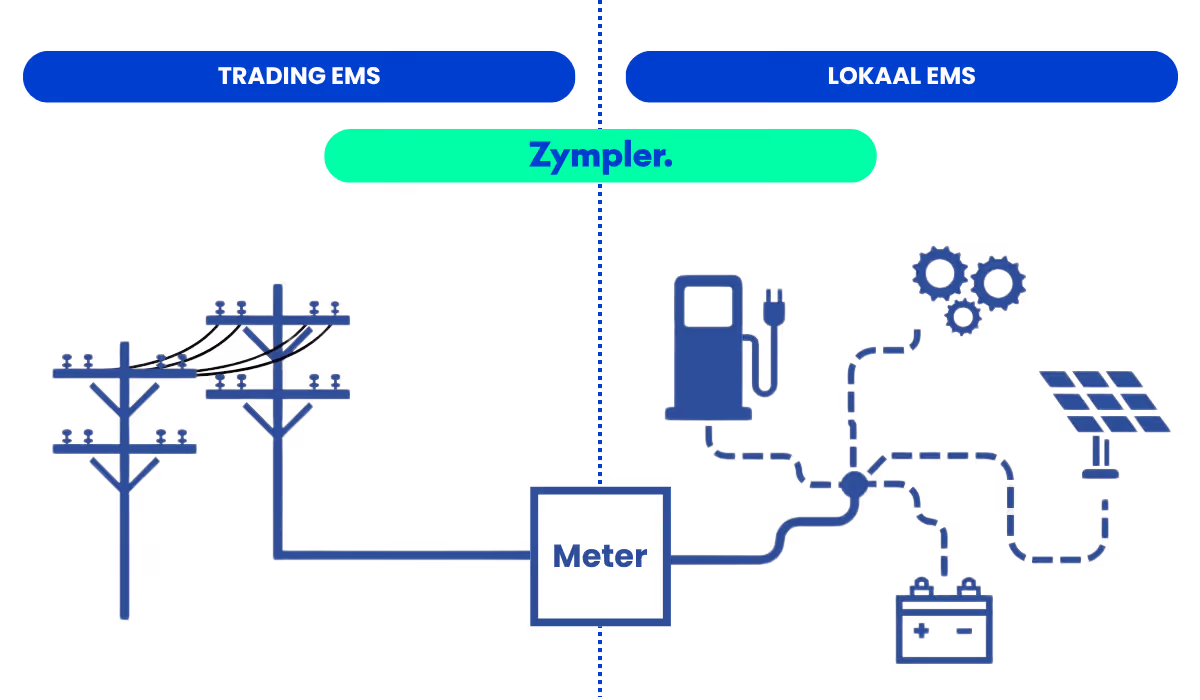
The meter forms the boundary between the public electricity grid and your installation. Everything that passes through that meter — both consumption and supply back to the grid — is visible to the grid operator and energy supplier.
What happens behind the meter remains invisible to them: how your battery charges, when charging stations activate, or what your internal consumption looks like.
That might seem like a technical detail, but it's fundamental. Because the party helping you optimize either views your installation from the perspective of the energy market or from your business process. And that difference determines what's possible.
The Systems: Trading EMS vs. Local EMS
You see this same division reflected in the systems that control these installations. Broadly speaking, there are two types of EMS:
- a trading EMS (front-of-the-meter)
- a local EMS (behind-the-meter)
Trading EMS: Optimizing for the Market
A trading EMS optimizes assets for market returns. The goal is simple: to earn as much as possible on energy markets such as day-ahead, intraday, and balancing markets (FCR, aFRR, mFRR).
This means the system continuously takes positions in different markets with varying closing times. For example, a battery might be scheduled hours in advance to fully discharge.
That's precisely where the complexity lies. You commit capacity in advance, while better opportunities might arise later. If you've already sold your battery on the intraday market, and aFRR turns out to be more attractive later, you can no longer capitalize on that.
More markets, therefore, don't automatically mean higher returns — they primarily mean more trade-offs.
Local EMS: Optimizing for Operations
A local EMS optimizes the on-site situation. It monitors the grid connection, controls batteries and charging stations, and ensures business operations continue.
Its primary function is control: keeping everything within the connection limits and ensuring assets are available when needed.
Some local EMSs also manage based on day-ahead prices, but that can be problematic. These prices are set a day in advance. If you react to them locally without coordination, you create imbalance for the energy supplier.
That's why good coordination is essential — and that's precisely where many local systems fall short.
Which EMS do I need?
The basic choice is quite simple:
- Do you have a single asset (such as a battery or solar panels) and sufficient capacity on your grid connection? → choose a trading EMS
- Do you have multiple assets, variable consumption, or a tight grid connection? → choose a local EMS
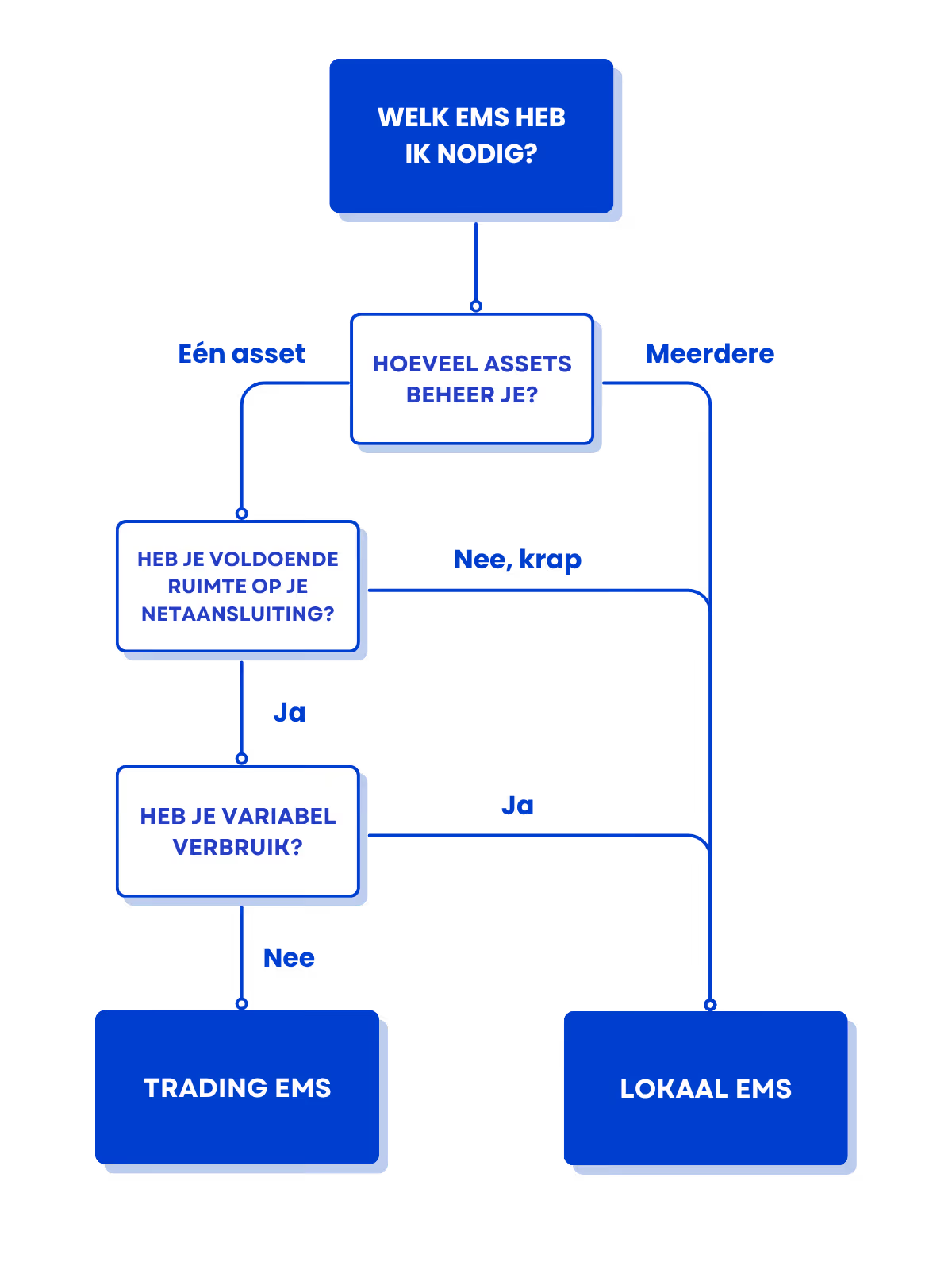
In the first case, you optimize purely for market value. In the second case, there's more to consider: you need to account for your grid connection, your consumption, and the availability of your assets.
That's precisely where the difference arises — because without insight into what's happening locally, you cannot optimally deploy those assets.
Why the combination often doesn't work
In practice, we often see a combination: a local EMS for control, alongside a trader for additional revenue. The problem is that these two operate independently. The trader doesn't know what's happening behind the meter and therefore cannot guarantee that a position is actually feasible.
That's why capacity is often statically allocated — for example, 50% for peak shaving and 50% for trading. That seems safe, but it's inefficient. Capacity then regularly lies unused, while at other times it falls short. You can solve this with predictions. The battery is deployed dynamically — 100% for trading when possible, and 100% for peak shaving when necessary.
How a local EMS still generates returns
This is where it gets interesting. A predictive local EMS doesn't start with the market, but with the question: what does this location need in the coming hours? Based on historical consumption, planned activities, and weather forecasts, the system makes a prediction of local consumption. Only then does it determine how much flexibility remains for the market.
That order is crucial: first optimize locally, then trade with the remaining flexibility. This results in a multi-layered business case — the first two layers of which are relatively certain.
1. Cost Savings
Suppose your company pays approximately €60/MWh in energy taxes and grid costs for consumption. Every MWh you don't have to draw from the grid during an expensive period directly generates that saving.
2. Local Revenues (such as EREs)
By storing solar energy locally and using it smartly, you can create additional value. Consider EREs (Energy Efficiency Units — certificates representing the value of locally consumed green electricity), which currently range roughly between €200 and €300/MWh for 100% green electricity.
3. Market Optimization
Only then does the market come into play. Suppose there's regularly a €150/MWh spread between charging and discharging on the day-ahead market. By storing solar energy and using or selling it later, that return accumulates.
Concrete Example
Take a 1 MWh battery:
- €60/MWh savings on grid costs and taxes
- ~€150/MWh from day-ahead optimization
- ~€100/MWh extra from EREs by storing green electricity
That quickly brings you to €300 per MWh per cycle, without being dependent on extreme market prices.
If you achieve this, for example, 200 days a year with one cycle per day, you're looking at:
→ €60,000 per year
And we haven't even included imbalance markets. In practice, we see that these often increase returns by tens of percent. The core: your business case is already solid before you even need the market. The market is upside. This makes the business case for assets with a local EMS much more robust. And in this example, we haven't even included any potential savings on grid management costs.
To truly achieve this day-ahead optimization, it is important that the local EMS is also predictive can operate. Reactive systems only read the main meter and operate independently of actual day-ahead prices, making them suboptimal.
One system, one optimum
What we observe in practice is that projects perform best when a single system both understands the local situation and has market access.
Not two systems operating in parallel, but a single system that prioritizes correctly:
First, optimize locally, then trade with the remaining flexibility.
This prevents capacity from being locked into a single purpose, and allows for continuous switching between peak shaving and trading.
Conclusion
The choice of an EMS ultimately boils down to one question: do you optimize for the market, or for your own operations?
If you have capacity and a single asset, a trading EMS will suffice.
However, if you have multiple assets, depend on your grid connection, or require certainty in your business process, a local EMS is indispensable.
And you get the most out of it when these two worlds converge — in a single system that optimizes locally and understands the market.
The grid doesn't wait.
Every month without proper management means lost margin.
Zympler can be immediately deployed on existing infrastructure.