
An e-truck can easily cost twice as much as a diesel variant to purchase. Yet, more and more transport companies are operating e-trucks, because the purchase price isn't the whole story. It's the Total Cost of Ownership (TCO) that ultimately determines whether an e-truck is chosen. One of the most significant factors in determining TCO, over which users have direct influence, is the price at which the vehicle is charged. In this article, we explain the impact of charging prices on TCO and how an EMS can help keep these costs under control.
The pressure to electrify
From July 1, 2026, a new kilometer charge will replace the current Eurovignette for all trucks over 3,500 kg. Instead of a fee per time period, you will now pay per driven kilometer, with a rate depending on the emission class. Diesel vehicles will pay up to approximately 20 cents per kilometer, while zero-emission trucks will pay a significantly lower rate or even nothing. Vehicle excise duty will be reduced to compensate, but ultimately, the cost per driven kilometer for diesel will be clearly higher, and for electric vehicles, it will be lower.
On top of this comes the rollout of zero-emission zones. In cities like Amsterdam and Rotterdam, only emission-free vans and trucks have been allowed into the city center since early 2025, and dozens of other municipalities will follow between now and 2030, with transitional arrangements for heavy trucks until 2030. At the same time, CSRD regulations compel large companies to report on emissions across their entire supply chain, including those from the transport services they procure. As a result, their clients are becoming increasingly critical of the footprint of their transport providers, and customers are more frequently including green transport requirements in their tenders.
https://www.tln.nl/kennis/duurzaamheid/csrd
So the question is no longer whether, but when and how you make the switch. And that's precisely where the TCO calculation becomes crucial.
What TCO consists of
The Total Cost of Ownership of a truck consists of four main components:
- Purchase costs - the truck itself, plus any charging infrastructure, after deduction of subsidies (such as AanZET and SPRILA).
- Energy costs - for diesel or electricity over the entire operational period. For electric vehicles, this is the all-in electricity price in €/kWh, multiplied by the consumption per kilometer and the total number of kilometers.
- Maintenance and tires - cumulative over the lifespan. For an e-truck, these are structurally lower than for a diesel truck.
- Levies, taxes, and revenues - truck levies, vehicle excise duty, and for electric vehicles, ERE revenues as a negative cost item.
The purchase price is what immediately stands out in every quote. But measured over six years, the other three components combined are many times larger. That's where the opportunity or risk for your business case lies.
The Basic Calculation
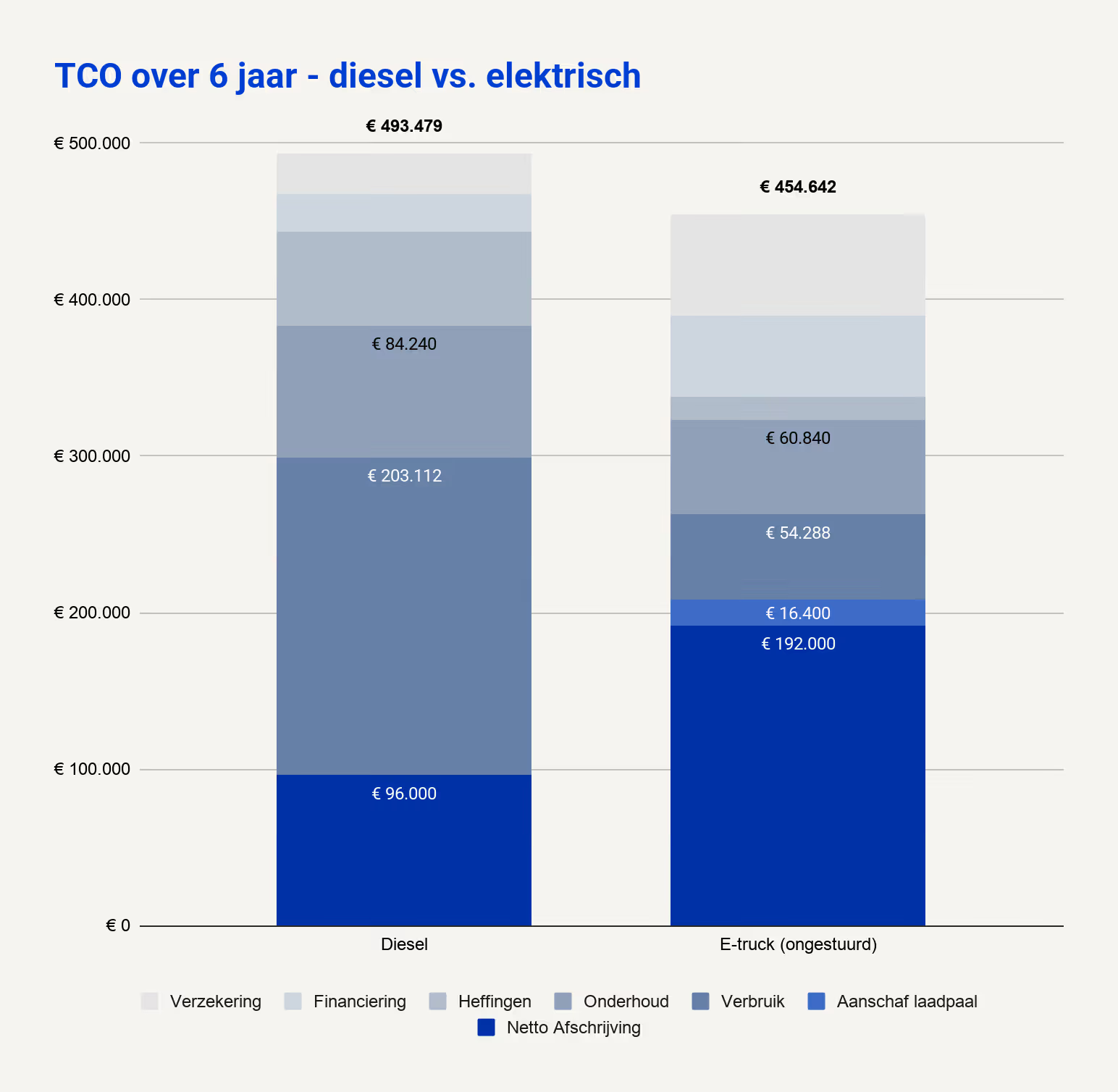
Let's take a concrete case. A 40-ton tractor for national distribution transport, 78,000 kilometers per year, over a six-year period. The truck is charged via a 150 kW fast charger at its own depot. No smart control, just plug in and charge.
Capital costs are higher than for diesel. An e-truck plus charging station will cost you around €250,000 upon purchase (after AanZET and SPRILA subsidies). A diesel variant costs approximately €120,000.
https://cedelft.eu/wp-content/uploads/sites/2/2024/03/Stappenplan-ZE_def.pdf
However, if we look at what the truck costs to operate, the picture changes. We deliberately use conservative assumptions here, so that the business case for the e-truck is more cautious than optimistic. The four major operational cost items at a glance:
- Electricity: an e-truck consumes 1.45 kWh per kilometer (including charging losses). Here, we are still calculating with an all-in electricity price of €0.18 per kWh: the price for unmanaged charging, including procurement, energy tax, and grid management costs. Further on, we will show how this price is structured and where there is room to reduce it.
- ERE Revenues: approximately €0.10 to €0.20 per kWh charged, to be deducted from your effective electricity price. You can read exactly how this works further on.
- Maintenance: for an e-truck approximately €0.13 per kilometer, compared to €0.18 for diesel.
- Truck Toll: for diesel approximately €0.20 per kilometer, for electric €0.038. That's less than a fifth.
Add these four up, and the picture looks completely different than based on the purchase price alone.
Over six years, this yields the following result:
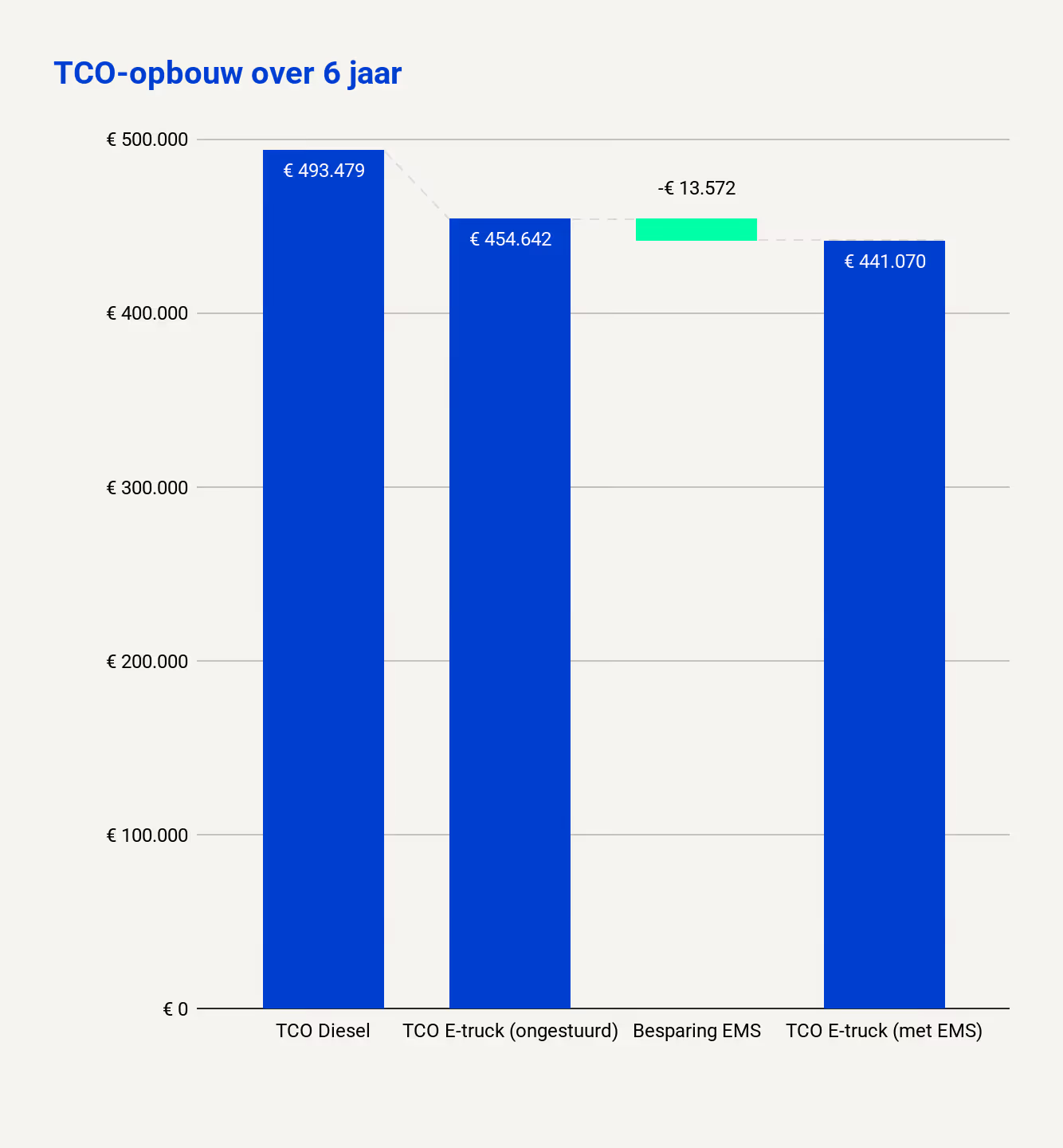
- Diesel: €493,000 total TCO
- E-truck: € 455,000 total TCO
This is the baseline scenario: the e-truck significantly outperforms diesel, based on current assumptions regarding electricity price, consumption, and levies.
But one of those assumptions is not a fixed given: that electricity price of €0.18 per kWh. And that's precisely where the risk lies, as well as a huge opportunity to strengthen the business case.
The composition of the electricity price
To understand where the opportunity lies, you need to look at what that €0.18 per kWh actually covers. The price you pay at your own depot is not a simple, fixed amount. It's composed of three layers.
The first layer is the base electricity price and energy tax. The base purchase price of electricity fluctuates around 8 cents per kWh. On top of that comes the energy tax, based on a tiered system: the more you consume, the lower the rate per kWh. With just a few e-trucks, you quickly reach the higher consumption tiers and only pay 3.7 cents per kWh in tax.
The second layer is the grid management. A depot with fast chargers means a large-scale business connection, and with that, you pay a consumption tariff per kWh to your grid operator, on top of the electricity price itself. That tariff depends on the type of connection, but it's a fixed cost item that scales with your electricity consumption. This is often around 2 cents / kWh.
The third layer consists of the ERE revenues. For every kWh you charge via the grid (statistically 50.5% renewable in 2026), you generate emission reduction units: a tradable certificate representing 1 kg of avoided CO₂. At current market prices, this yields approximately 10 cents per kWh (variable, depending on market price). Do you charge with demonstrably 100% locally generated green electricity? Then the number of EREs per kWh doubles, and with it, the revenue.
https://www.emissieautoriteit.nl/documenten/2026/02/02/inboeken-elektriciteit-particulieren
The effect of unmanaged charging
What still happens too often is that trucks arriving after their shift are immediately and unmanagedly connected to the charger. That is precisely the wrong time. In the late afternoon, market demand peaks and solar energy declines. During evening peak hours, day-ahead tariffs are at their highest level of the day. Anyone who charges at full throttle at that moment pays top price.
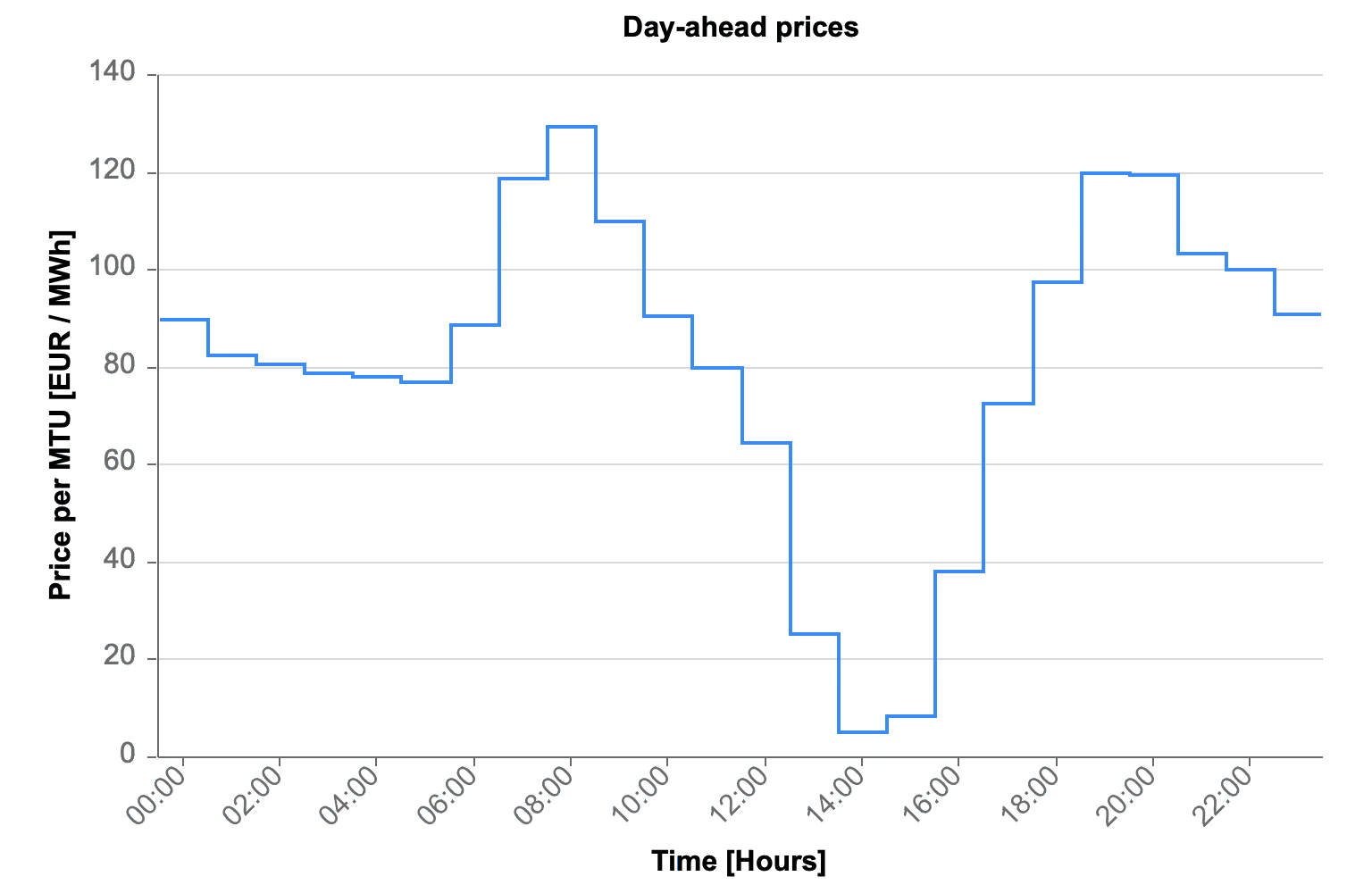
A high price on a single evening isn't the problem. That gets averaged out over thousands of charging sessions. The danger lies in the structural habit: if you consistently charge uncontrolled during peak hours day in and day out, your average all-in electricity price will creep up over the entire lifespan. And it's precisely that average that significantly impacts the TCO.
The graph below shows where the limit lies. With a six-year TCO, the e-truck becomes exactly as expensive as diesel once your average electricity price reaches 35 ct/kWh . That's the tipping point. If you stay below that, it's advantageous to choose an electric truck. If you exceed it, for example, by stubbornly continuing to charge during peak hours, your advantage evaporates, and you'll end up paying more than with diesel.
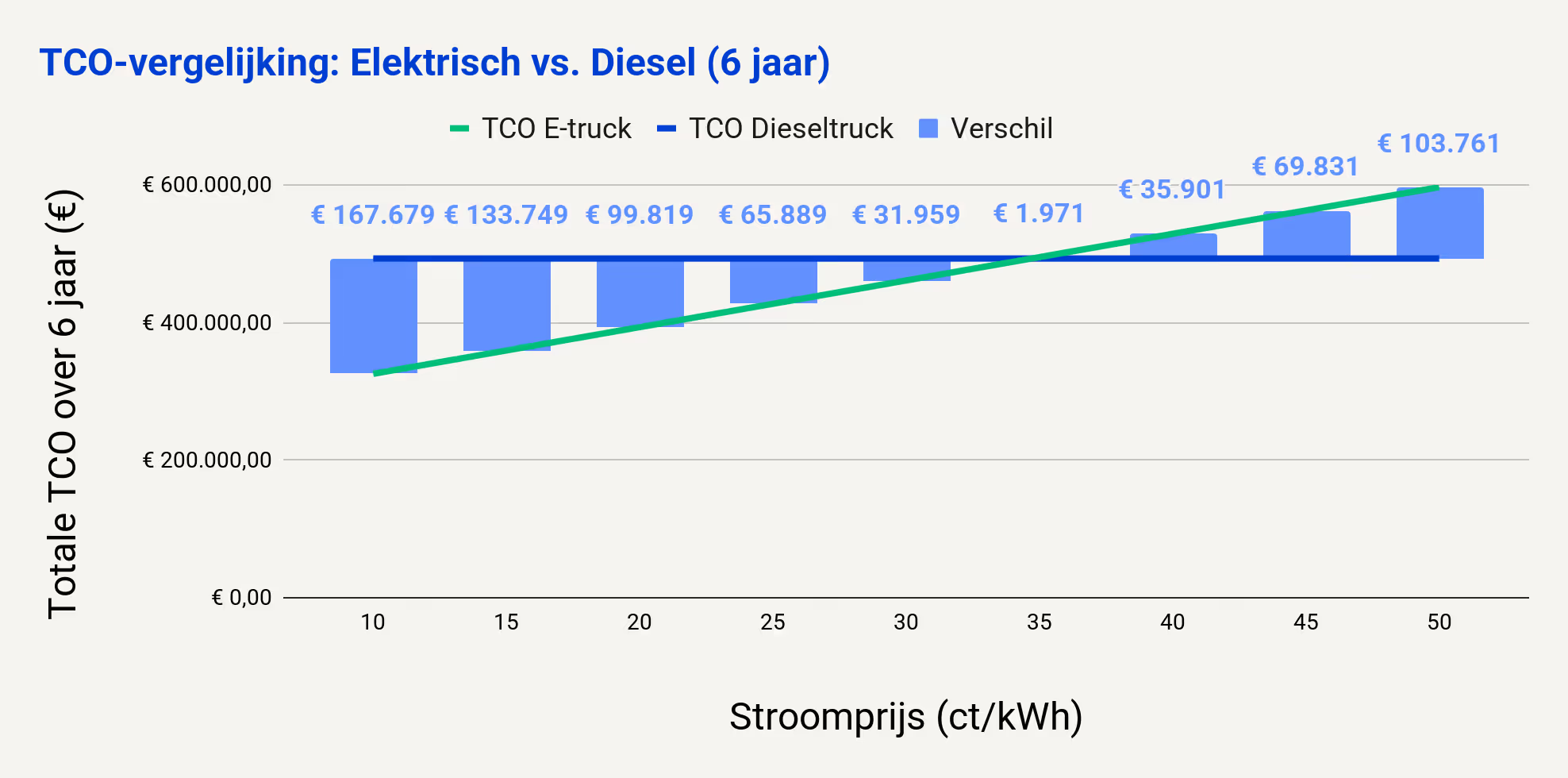
This tipping point of 35 ct/kWh is based on a conservative diesel price of €1.55 per liter. The current bulk price is closer to €2.00 per liter. If we calculate with that, the tipping point shifts to 43 ct/kWh. So, in practice, your margin before electric becomes more expensive than diesel is even wider than the graph suggests.
Erik Nagel, director of Transportbedrijf R. Nagel, which is putting ten electric trucks into operation this year, immediately recognizes this: "It's essential that you can charge at home and have the price per kWh under control. If you have to charge away from home at high commercial rates, the business model quickly proves unprofitable."
The effect of an EMS
Precisely that risk – consistently charging during expensive peak hours – is mitigated with an Energy Management System (EMS). The system starts by asking: what does the operation need? It then intelligently distributes charging sessions across hours when electricity is cheap, and keeps the simultaneous power demand within the limits of your existing connection.
That saves you money in two ways. Firstly, the simultaneous demand stays within your current connection, eliminating the need for expensive grid reinforcement and avoiding waiting for the grid operator. You simply use the capacity you already have, but more intelligently.
Secondly, and this is where the biggest gain lies, you purchase your electricity at the right times. By shifting charging sessions to the cheapest hours, you push down your purchase price. Exactly how much you save depends on your original charging profile and what your energy contract allows, but in practice, it quickly amounts to 1 to 4 cents per kWh. If you calculate with 2 cents, in the middle of that range, that's over €13,500 on the TCO over six years. Profit you gain from the exact same truck.
And with that, an EMS is more than just a saving on your electricity bill. Think back to the 35 ct/kWh tipping point. Anyone who charges uncontrolled leaves it up to the day-ahead market to determine which side of that threshold they land on. An EMS removes that element of chance: by consistently directing your charging sessions to cheaper hours, you keep your average electricity price well to the left of the tipping point. You actively ensure the business case remains viable, instead of just hoping for it.
The graph below translates that into euros. Without smart control, you're at €455,000, already well below diesel. With an EMS, you drop to €441,000, even further away from the tipping point.
And let's not forget that an EMS provides (1) insights/reports, (2) ensures everything stays neatly within the connection, thereby safeguarding operations, and (3) increases the % of green energy, which is good for 'demonstrably green driving'.
Conclusion
Electric driving is profitable. Even those who blindly plug in their truck will drive cheaper than with diesel over six years. So the question isn't whether it's possible, but how certain you want to be of that outcome.
Because the risk remains the electricity price. Anyone who charges uncontrolled during peak hours leaves it up to the market to determine which side of the tipping point they land on. With smart control, you remove that element of chance. By consistently shifting your charging sessions to cheaper hours, you keep your average electricity price low enough that your TCO almost always compares favorably to diesel.
That's the core: an EMS not only makes electric driving profitable, but predictably profitable. The truck offers the advantage; smart control ensures you actually realize it.
The grid doesn't wait.
Every month without proper management means lost margin.
Zympler can be immediately deployed on existing infrastructure.